




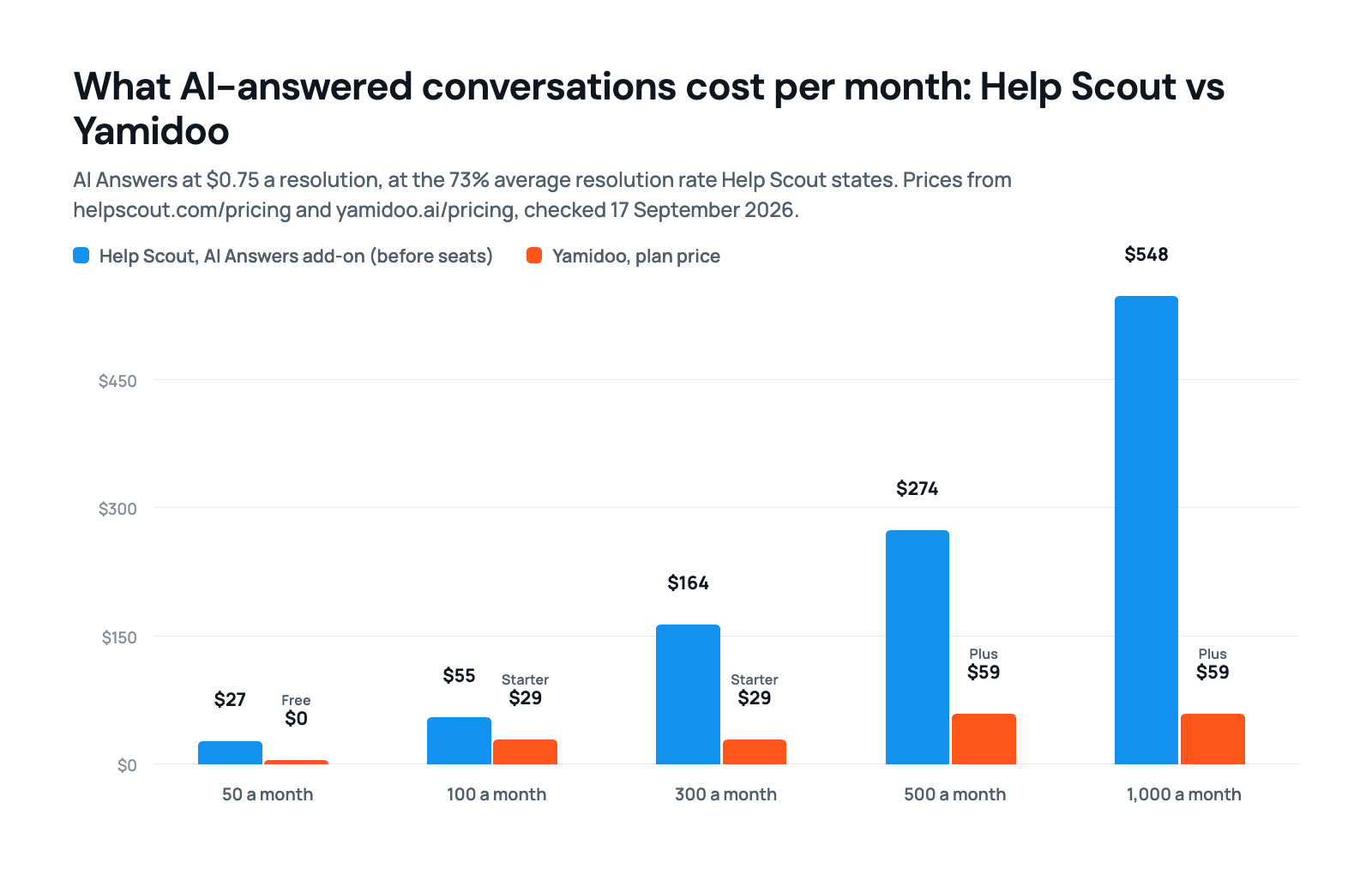
Stay with Help Scout if your team lives in a shared inbox and answers on email, chat, WhatsApp and Instagram. It is very good at that, and this page will not talk you out of it. Choose Yamidoo if what you want is the widget on your site answering the questions visitors already ask, with a person able to step in. At 300 AI-answered conversations a month, that is about $164 in resolutions plus seats, against $29.
Help Scout is help desk software: a shared email inbox first, then Docs (a knowledge base), Beacon (a help widget with chat) and AI Answers, an AI agent in Beacon that answers from your Docs and website and is billed per resolution.
Yamidoo is an AI support chat built by WPZOOM: answers from your own pages, with the source linked under every one and a person one click away. AI answers are on every plan, the free one too.
The whole argument is in the unit each of them bills. A resolution is a conversation where the AI replied and the visitor did not escalate, search, ask again or say they still needed help. A conversation is a conversation either way, and that is the difference the numbers below come from.
We were Help Scout customers from 2014 to 2025 and still use it for email. We built Yamidoo to replace the chat, after running AI Answers on our own site for a month; the numbers from that month are further down.
The short version
- Price. Help Scout is priced per user, from $30 a month each, and the customer-facing AI is extra at $0.75 per resolution. Yamidoo is priced per site, from $0, and AI answers are what the plan is for.
- Shape. Help Scout is a help desk with an AI add-on in its widget. Yamidoo is an AI support chat with live human takeover built in, and nothing else: no email inbox, no ticketing, no WhatsApp.
- WordPress. Help Scout has no WordPress plugin; you paste a script with a third-party plugin. Yamidoo’s plugin is on wordpress.org, connects in one click, and shows the customer’s orders and licenses next to the chat on WooCommerce and Easy Digital Downloads stores. Freemius connects from the dashboard with a product token.
Yamidoo vs Help Scout
| Help Scout | Yamidoo | |
|---|---|---|
| Cheapest paid plan | Standard, $30 per user a month; AI Answers extra | Starter, $29 a month per site: 300 AI-answered conversations, human replies free |
| On annual billing | $25, $45 and $75 per user a month | $290, $590 and $990 a year, so $24, $49 and $83 a month |
| Free plan | 5 users, 1 Inbox, 1 Docs site with 10 articles, 100 contacts a month; AI Answers for the first 3 months only | 50 AI-answered conversations every month, 100 pages, 1 seat, no card, no expiry |
| What you pay for | Users, plus $0.75 per AI resolution | AI-answered conversations only |
| 300 AI conversations a month | About $164 in resolutions at the stated 73% rate, plus seats | $29 (Starter) |
| 1,000 AI conversations a month | About $548, plus seats | $59 (Plus) |
| Where the AI gets its answers | Your Help Scout Docs site, plus website pages and public documents you add as sources | Your pages, sitemap, pasted text and hand-written Q&A pairs |
| Does the AI show its source | Not stated on Help Scout’s pages | Every answer links the page it came from |
| When the AI does not know | Offers “I still need help”, which opens a conversation in the Inbox | Says so and offers a person |
| Human takeover | The visitor escalates; your team answers from the Inbox as email or chat | Your team watches live and can take over mid-answer with a reply already drafted; the AI resumes when they leave |
| Channels | Email, live chat, SMS, WhatsApp, Instagram, Messenger | Website chat only |
| WordPress | Script snippet via a third-party plugin | Free plugin: one click to connect, no theme edits; WooCommerce and EDD orders, licenses and subscriptions next to the conversation, and Freemius through a dashboard token |
| Knowledge base | Docs, hosted by Help Scout, 10 articles on Free | Your own site is the knowledge base; Content Gaps lists what visitors asked that it could not answer |
| Remove the badge | Beacon branding is configurable on paid plans | Included on Pro, $99 a month |
| Team seats | 5 on Free, then $30 to $90 each a month | 1 on Free and Starter, 3 on Plus, 5 on Pro; extra seats $19 a month each, on request |
| Over the limit | Resolutions bill until the cap you set; then the AI turns off | We email you at 75%, 90% and 100%, then AI answers pause until the next period. No overage billing |
| Trial | 15 days of Standard or Plus, no card; 3 months of unlimited AI Answers | The Free plan is the trial, and it does not end |
| Getting your data out | Reports export to CSV or XLSX; the customer export leaves out conversation history, so raw conversations come through the Inbox API | Transcripts by email, one conversation at a time. No bulk export yet |
| Apps | Desktop and mobile | Web dashboard |
Yamidoo plans and limits are on the pricing page; the full feature list is on features.
What Help Scout costs in 2026
Help Scout pricing has two moving parts, both on its pricing page: users, meaning members of your team with a login, and AI Answers resolutions. Everything else is gated by plan.
Help Scout’s plans
| Help Scout plan | Monthly billing | Annual billing | What it includes |
|---|---|---|---|
| Free | $0 | $0 | 5 users, 1 Inbox, 1 Docs site with 10 articles, 1 Beacon, 100 contacts a month, 30 days of reporting |
| Standard | $30 per user | $25 per user | Up to 25 users, 2 Inboxes, 2 Docs sites, 5 Beacons, live chat and SMS, WhatsApp, Instagram and Messenger, 150 basic workflows, AI Inbox assistant |
| Plus | $54 per user | $45 per user | Up to 50 users, 5 Inboxes, 3 Docs sites, unlimited Beacons, unlimited AI Drafts, 500 advanced workflows, Salesforce, Jira and HubSpot |
| Pro | $90 per user | $75 per user | Minimum 10 users, 10 Inboxes, 5 Docs sites, unlimited workflows, SSO, HIPAA, a dedicated onboarding specialist |
Extra Inboxes are $10 a month each on annual billing and $12 on monthly; extra Docs sites are $20 and $24. A contact is “someone who received a reply from your team or had their question resolved by the AI assistant”; the Free plan caps them at 100 a month, paid plans do not count them.
The word survives from a pricing experiment. In late 2024 Help Scout moved to contact-based billing, where AI resolutions counted as contacts and the bill tracked volume rather than headcount. Per-user pricing came back during 2025 and the contact-based plan is now legacy, closed to new accounts. On today’s plans the count only bites on Free.
AI Answers
The AI that talks to your visitors is a separate line:
| AI Answers | Price |
|---|---|
| First three months on any new account | Unlimited resolutions, free |
| After that | $0.75 per resolution, on paid plans |
| Spending cap | Optional monthly cap; the AI switches off for the rest of the month when it is reached |
| Pre-paid discounts | Available, not published |
Four Help Scout features carry similar names and only one of them reaches your customers. AI Answers is the chatbot in Beacon, and the only one billed per resolution. AI Assist (rewrite, shorten or translate a reply), AI Drafts (draft a reply from past conversations) and AI Summarize help your team rather than your visitors, and they are included: AI Assist from Standard up, AI Drafts and AI Summarize from Plus up.
A resolution, in Help Scout’s words, “is counted only if the customer receives an AI response and doesn’t use escalation, search the knowledge base, ask more questions, or indicate that they need more help.” One resolution is charged per conversation, however many questions the AI answers in it. Help Scout puts the average resolution rate at 73%.
That rate is the number to plan around. A site whose widget gets 300 AI conversations a month can expect about 219 resolutions, or $164 a month for AI Answers, plus the seats. Two people on Standard bring it to $224 a month. The same 300 conversations on Yamidoo are the Starter plan at $29, or Plus at $59 if three people share the inbox.
The case for Help Scout, and the case against
What Help Scout does well
- The inbox. Shared email with assignments, collision detection, saved replies, workflows and reporting, refined over fifteen years. It is why we stayed a customer for eleven of them, and why we still use it for email.
- Docs. A hosted knowledge base with its own search, branding and article editor, wired into Beacon so the widget can suggest articles by page URL.
- Every channel in one place. Email, live chat, SMS, WhatsApp, Instagram and Messenger land in the same Inbox on Standard and up, with mobile apps for the team.
- Escalation is one click. Help Scout’s own line is “your team is always a click away”. A visitor who presses “I still need help” becomes a normal conversation in the Inbox, and that conversation is not billed as a resolution.
- A spending cap on the AI. You can set a monthly ceiling and the AI turns itself off when it is reached. That is the right design for per-resolution pricing.
Why people look for a Help Scout alternative
The facts below are on Help Scout’s pricing page and help center; the reading of them is ours.
- You pay for seats before you pay for answers. The customer-facing AI is only available on paid plans once the trial ends, so the entry price for AI in the widget is a Standard seat at $30 a month plus $0.75 a resolution. On Yamidoo the entry price is $0.
- Per-resolution pricing rewards the wrong thing. The more questions the AI settles, the bigger the bill. A site that gets the same twenty questions a day is exactly the site that should automate them, and at 73% resolution that is about $330 a month in AI Answers alone.
- Silence counts as success. By Help Scout’s definition, a visitor who reads the AI’s reply and closes the tab is a resolution. Ask more questions and it is not; leave without a word and it is. It still charges you for the visitor who gave up.
- It is a help desk, and you pay for all of it. Workflows, SLAs, Salesforce, SSO and HIPAA are worth paying for when you use them. If the goal is a widget that answers questions from your docs, most of the plan table is weight.
- WordPress is a script snippet. Help Scout’s guide for adding Beacon to WordPress points you to a third-party custom-JavaScript plugin and says Help Scout is “not affiliated with that plugin or the developer of it”.
What we saw when we ran AI Answers
If you are looking for Help Scout reviews of the AI specifically, here is one month of our own traffic rather than a feature tour. We turned on AI Answers in Beacon on wpzoom.com in May 2025 and pulled the numbers after a month. Help Scout had marked 197 sessions as “Customer helped”. Reading them one by one, 95 were nothing of the kind: the visitor asked one question, the AI posted an answer or a link, and the visitor left. Forty-eight percent. The single biggest source was Beacon’s own suggested prompt, “I have a pre-sales question!”, which the AI answered with a link to a page and which then counted as helped every time someone clicked it, because nobody replies to a link.
Under the billing in force that year, each of those counted as a contact we paid for. When we sent Help Scout the analysis, their support team agreed that these customers “weren’t helped as our human brains would understand it”, credited us $25, and pointed out that the AI was designed for direct questions, not statements. Both fair. The definition in force today excludes visitors who ask a second question. It still counts the ones who leave.
That month is the reason Yamidoo shows the source under every answer, lets you watch a conversation live, and counts conversations rather than resolutions: a conversation is a conversation whether the visitor was helped or gave up, so there is nothing to argue about.
How Yamidoo works
Yamidoo replaced Beacon on wpzoom.com in July 2026. By 11 September it had handled 439 conversations, 85% of them with nobody on our team stepping in, at an average reply of 7 seconds. To see what it would answer on your own site, run the free Support Readiness Scan: it reads your public pages and lists the questions it can already answer.
Where the answers come from
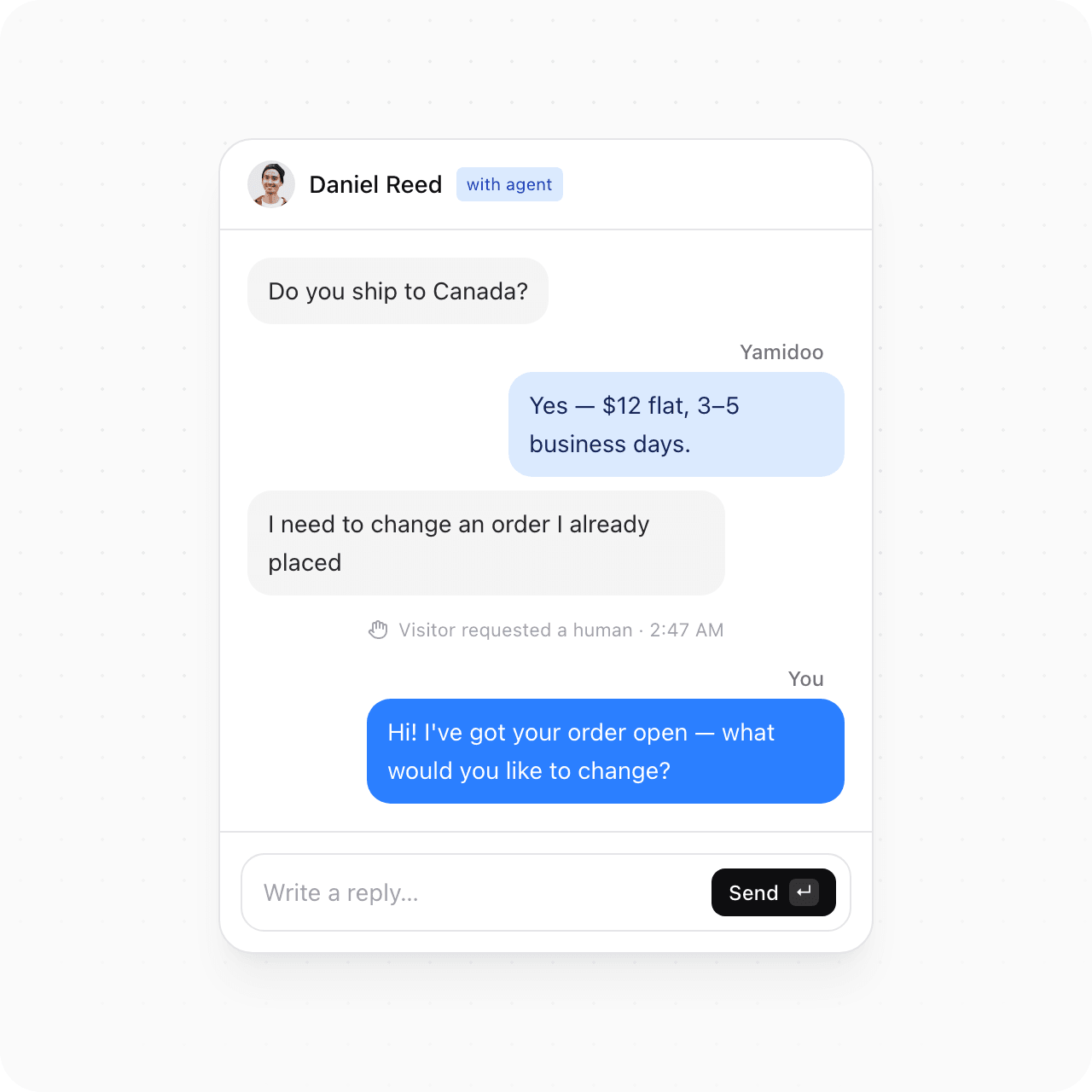
Answers from your own content. Yamidoo indexes your crawled pages, a sitemap, pasted text and Q&A pairs you write yourself, and answers visitors from that content only.
A source under every answer. Every reply links to the page it came from, so the visitor can check it and so can you. When it does not know, it says so and offers a person instead of inventing an answer.
Content gaps. The Content Gaps report lists the questions it could not answer well, grouped by topic, so you know which page to write next.
Watch every conversation, step in when you want
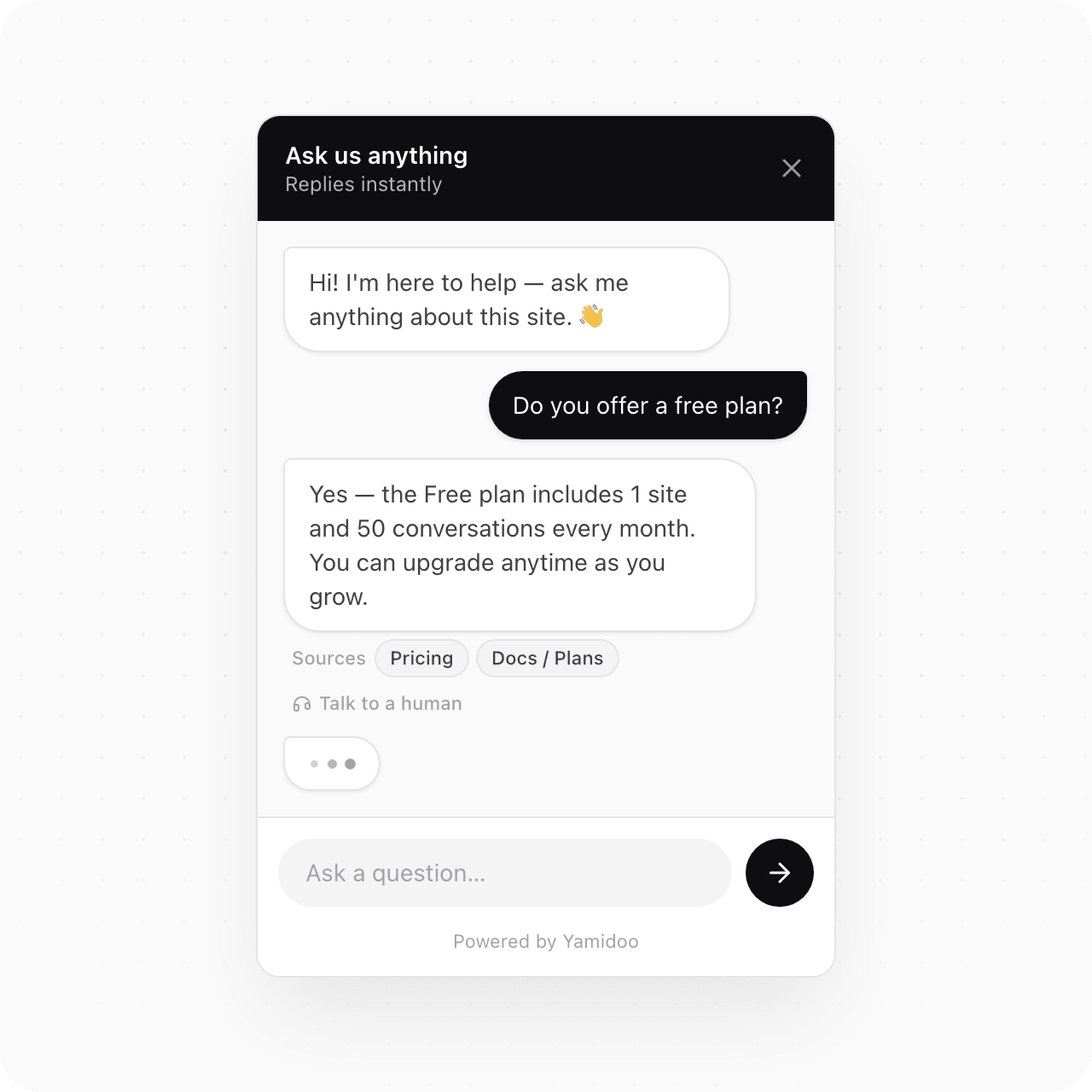
A live monitor. It shows who is on the site and every conversation as it happens. You can watch an answer stream in real time.
Takeover in one click. Take over even mid-answer, with a reply already drafted for you to edit or send. Your name and photo replace the assistant in the widget header. Step away and the AI takes the thread back.
A handoff the visitor can ask for. At any point a visitor can ask for a person, and the conversation is flagged for your team. It costs nothing extra when they do. A conversation counts as one conversation whether the AI finished it or you did.
On stores, Yamidoo sees what Help Scout’s widget cannot. Connect WooCommerce or Easy Digital Downloads through the WordPress plugin, or Freemius from the dashboard with a product token, and the customer’s orders, licenses and subscriptions sit next to the conversation for your team, and, if you switch it on, the AI can answer “when does my license expire?” for customers who are logged in to your site.
Three smaller things that come up when people compare the two widgets: the widget’s own text (buttons, placeholder, notices) comes in 14 languages on paid plans while the AI answers in the visitor’s language on every plan, visitors can attach PDFs, PNGs and JPGs up to 10 MB on any paid plan and the AI reads them, and answer ratings with CSAT reporting are on every plan, the free one included.
What happens to your Help Scout Docs
This is the first practical question when you leave. You have a Docs site with articles in it. Where do they go?
The honest answer about migration first: there is no Help Scout Docs importer in Yamidoo, and pretending otherwise would cost you an afternoon. What there is instead: your Docs site is a website, so you point Yamidoo at its URL or its sitemap and it crawls it like any other source, next to your own pages, text you paste in, and Q&A pairs you write by hand. Hand-written pairs are treated as authoritative and outrank anything crawled, which is the fix for the one answer it keeps getting wrong. The Free plan indexes 100 pages from one source of each type. Paid plans take unlimited sources and 500 to 5,000 pages, re-synced monthly, weekly or daily.
What you give up is real, so here it is plainly: a hosted, branded, searchable help center with its own article editor. Yamidoo does not host articles. If that help center is the part you actually pay Help Scout for, keep paying for Docs, or look at a knowledge base specialist instead of at us.
What replaces the part of Docs most teams use most, the report telling you which article to write next, is Content Gaps: the questions visitors asked that the AI could not answer well, grouped by topic.
Other Help Scout alternatives, and where they fit
Yamidoo replaces one part of Help Scout, the widget. If you are replacing the whole help desk, these are the Help Scout competitors worth knowing about, and what each one is actually for.
- Zendesk, if you are scaling into enterprise support and need SLAs, routing and a marketplace of integrations. Nobody picks it to save money.
- Freshdesk, for multi-channel ticketing across email, chat, phone and social. One correction, because it matters if you are shopping on price: Freshdesk is still widely listed as the free option, and its own pricing page starts at $19 per agent a month on annual billing, with a 14-day trial and no free plan.
- Zoho Desk, the budget omnichannel option, and the real free tier in this group: a Free Edition with three user licenses. It makes most sense if you already run other Zoho software.
- Front, if what you love about Help Scout is the shared inbox and you want heavier collaboration on top of it.
- Hiver, if you want the shared help desk to live inside Gmail.
- HubSpot Service Hub, if support belongs next to the CRM your sales team already uses.
- Intercom, if you want messaging first and an AI agent, and the budget is there.
If you would rather host it yourself, the open source answers are FreeScout, which is the closest thing to Help Scout’s inbox and has no AI in the widget, and Chatwoot, a shared inbox with website chat that you can self-host or buy as cloud.
And on the chat side of the line, Tidio is a suite with every social channel and a chat flow builder; its AI is metered per conversation. We compared it here.
Which one is for you
When to stay with Help Scout
- Your team answers customers by email, and you want that inbox, its workflows and its reporting.
- Your customers write on WhatsApp, Instagram, Messenger or SMS and you want one place for all of it.
- You already maintain a Docs site and want the widget to suggest articles by page.
- You are past the free trial of AI Answers, the spending cap suits you, and $0.75 a resolution is cheaper than a seat.
When Yamidoo fits better
- Most of your support is the same questions your site already answers.
- You want AI answers on the free plan, every month, with no card and no seat.
- You want to see conversations live and step in yourself, then hand back.
- Your site runs WordPress, and your store runs WooCommerce, Easy Digital Downloads or Freemius.
- You want one bill you can predict: conversations, not seats plus resolutions.
- You can keep Help Scout for email. That is how we run it.
